
Your Nervous System Online:How to Build Co-Regulated Community in Digital Spaces
Part Two of a Series — Read Part One at Stockheart.com
By Dr. Michele Renee, DC, MAc, LMT

A soft-focus photograph of two hands cradling a steaming mug, light pooling across a wooden table. Beside the mug is an open laptop with a video meeting taking place. In the background, muted, earthy tones create a sense of warmth and calm. The image evokes rest, small rituals, and the tender attention we give our bodies during recovery—a reminder that healing often begins with simple, steady moments in coregulation with others, even if that happens online.
We Were Never Supposed to Do This Alone
In my last piece — published over at Stockheart.com — I made the case that co-regulation isn’t a wellness trend. It’s a biological imperative. Your nervous system was literally shaped by 300,000 years of humans surviving in tribes, regulating each other’s threat responses through proximity, voice, touch, and shared rhythm. Isolation isn’t neutral. It’s experienced by your body as danger — because for most of human history, being alone meant you didn’t survive.
But here’s the question I kept sitting with after writing it: what about those of us whose primary community lives online?
I’m not just asking theoretically. I think about my patients managing chronic illness who can’t always get to a room full of people. I think about the person in a rural town whose nearest healing circle is three hours away. I think about the Long COVID patient who is isolated twice over — by illness and by a society that has moved on. I think about the TENDing Method participants who show up week after week in a virtual cohort and tell me, with real emotion, that this group has changed something for them.
And I think about myself — a practitioner who has found genuine nourishment and even nervous system settling in online spaces that were thoughtfully held.
So is online co-regulation real? Can a screen actually transmit safety? And if so — how do we build digital communities that actually do that work, rather than ones that leave us more dysregulated than when we arrived?
That’s what this piece is about.

A profile of a young Black woman on a video call, fingers splayed over a soft knit flannel shirt captured in warm, natural light. The image conveys quiet attention and self-care: a gentle pause to notice breath, heartbeat, and the subtle signals the body sends. Textures—skin, fabric, pillows, and the faint shadows between—lend a sense of intimacy and grounded presence. This is a moment of attunement, inviting curiosity, compassion, and the practice of listening to what the body needs.
What the Screen Can (and Can’t) Carry
Let’s talk through what we’re working with. In-person co-regulation is multidimensional. Your nervous system is reading the other person’s face, the tone and rhythm of their voice, the warmth of their physical proximity, the subtle cues of their body posture and breath. Dr. Stephen Porges, whose Polyvagal Theory gave us the neurological framework for co-regulation, describes neuroception as your body’s ability to scan the environment for safety or threat below conscious awareness — and in person, you’re getting all of that input at once.
A screen narrows that bandwidth. Touch disappears entirely. Physical proximity — the literal warmth of another body — is absent. And there is real loss there. I don’t want to paper over it.
But here’s what I find genuinely fascinating: more transfers than most people expect.
What Does Transfer
Voice and Prosody
According to Polyvagal Theory, the prosodic qualities of speech — melody, rhythm, warmth, pace — are processed by your nervous system as cues of safety or danger, often below conscious awareness. A warm, melodic tone activates the ventral vagal pathway; a flat or strained voice signals threat.
This means that in a voice or video call, a podcast, a voice memo, or even a live video where you can hear someone breathing and pausing and laughing — your nervous system is receiving real regulatory input. It’s not the same as sitting next to someone. But it’s not nothing. It’s a great deal.
Porges, S.W. (2011). The Polyvagal Theory: Neurophysiological Foundations of Emotions, Attachment, Communication, and Self-Regulation. Norton. | IE Center for Health and Well-Being: "Your Voice Says More Than Words" (2025)
Facial Expression and Eye Contact
When we can see each other on video — even imperfectly, even through a small rectangle on a screen — our mirror neurons are active. We’re reading microexpressions, watching eyes soften or widen, seeing someone nod. The Polyvagal Institute notes that facial expression is one of the primary channels through which humans exchange safety signals. Video carries this, however imperfectly.
This is also why turning your camera on matters. It’s not a preference — it’s regulatory data for everyone in the room.
Polyvagal Institute: "What is Polyvagal Theory?" (polyvagalinstitute.org)
Rhythm and Synchrony
One of the most surprising findings in recent research is how much rhythm matters across distance. When people breathe together, their nervous systems begin to entrain — to literally synchronize. A 2026 study published in Scientific Reports found that synchronized breathing enhanced empathy and social bonding, and that shared respiratory rhythms strengthen positive emotional connections through the same mechanisms as singing, chanting, and laughter.
This means that online group practices — guided breathwork, group meditation, even the shared rhythm of a structured call with consistent pacing and turn-taking — can generate real physiological synchrony. Your body is tracking the rhythm of the group even through a screen.
Shared breath of joy enhances empathy through breathing synchronization. Scientific Reports (2026). nature.com/articles/s41598-026-34981-0
Being Witnessed
One of the most powerful mechanisms of co-regulation is the felt sense of being seen. When someone reflects your experience back accurately — when you say something true and the room responds with recognition — your nervous system registers: I am not alone. My experience is real. I am not broken.
This happens in text. It happens in a comment thread. It happens in a Voxer voice message at 11pm from someone who gets it. Being witnessed doesn’t require physical presence. It requires genuine attunement — and that can cross a screen.

What Doesn’t Transfer
(And Why That Matters)
Physical touch is irreplaceable. The research on hand-holding and neural threat response — particularly James Coan’s work at the University of Virginia, which found that holding a trusted partner’s hand significantly reduced the brain’s threat response to physical pain — cannot be replicated digitally. Your skin has receptors that communicate directly with your vagus nerve. That pathway requires a body.
Coan, J.A., et al. (2006). Lending a Hand: Social Regulation of the Neural Response to Threat. Psychological Science. | Neurosity.co: "Co-Regulation: Nervous Systems in Sync" (2026)
Physical proximity also matters in ways we don’t fully understand yet. The sense of shared space — breathing the same air, occupying the same room — provides neuroceptive cues that a screen can’t replicate. And for people with significant nervous system dysregulation or early attachment trauma, in-person co-regulation may be the more essential starting point.
I say this not to discourage online community, but to be honest about what it is: a real and meaningful form of co-regulation that works best as one thread in a larger relational web — not as a permanent substitute for embodied connection.
What the Research Actually Shows
I’m a clinician and an educator, and I want to be careful not to overclaim. So let me tell you what the science actually says about online community and nervous system health.
The evidence is more robust than most people realize.
A 2023 prospective cohort study published in JMIR Formative Research followed adults with significant depression, anxiety, and loneliness through a digitally enabled peer support program over 90 days. The results were striking: participants showed a 50% decline in depression symptoms, a 29% reduction in anxiety, a nearly 15% improvement in loneliness scores, and measurable improvement in health-related quality of life — with an estimated reduction in annual medical costs of over $600 per participant.
Bravata, D. et al. (2023). Digitally Enabled Peer Support Intervention to Address Loneliness and Mental Health: Prospective Cohort Analysis. JMIR Formative Research. doi:10.2196/48864
These aren’t small effects. These are clinically significant changes in people’s nervous system states — measurable in standardized symptom scales — from online peer connection.
Additional research on online health communities has found that people turn to these spaces particularly when they face health-related stigma or have limited access to adequate support in their immediate social networks — two conditions that describe many of the people I work with. The research consistently shows benefits including reduced isolation, increased sense of being understood, and improved coping.
Wright, K.B. (2016). Communication in Health-Related Online Social Support Communities. Review of Communication Research, 4, 65–87.
What’s also interesting is the finding that the effects of emotional support in online communities tend to be strongest early in membership — when people first feel seen and less alone — while the effects of informational and social integration support strengthen over time as relationships deepen. This mirrors what we know about in-person therapeutic relationships: attunement first, depth over time.
How Could Peers in Online Health Community Help Improve Health Behavior. PMC (2020). ncbi.nlm.nih.gov/pmc/articles/PMC7246899/
The neuroscience is equally compelling. Porges’ Polyvagal Theory, and the growing body of research on prosody and the social engagement system, makes clear that vocal tone alone — the warmth and rhythm of a voice — can shift autonomic state. When we hear prosodic speech (warm, melodic intonation), the muscles in our ears literally relax, followed by the eyes and face. That’s not metaphor. That’s the middle ear muscles responding to acoustic safety cues through the vagal pathway.
Porges, S.W. as cited in Jorgensen, R. (2020). "Talk Time Featuring Dr. Stephen Porges." drrebeccajorgensen.com
A voice in your ear, someone who gets it, speaking warmly and truthfully, is a nervous system intervention.
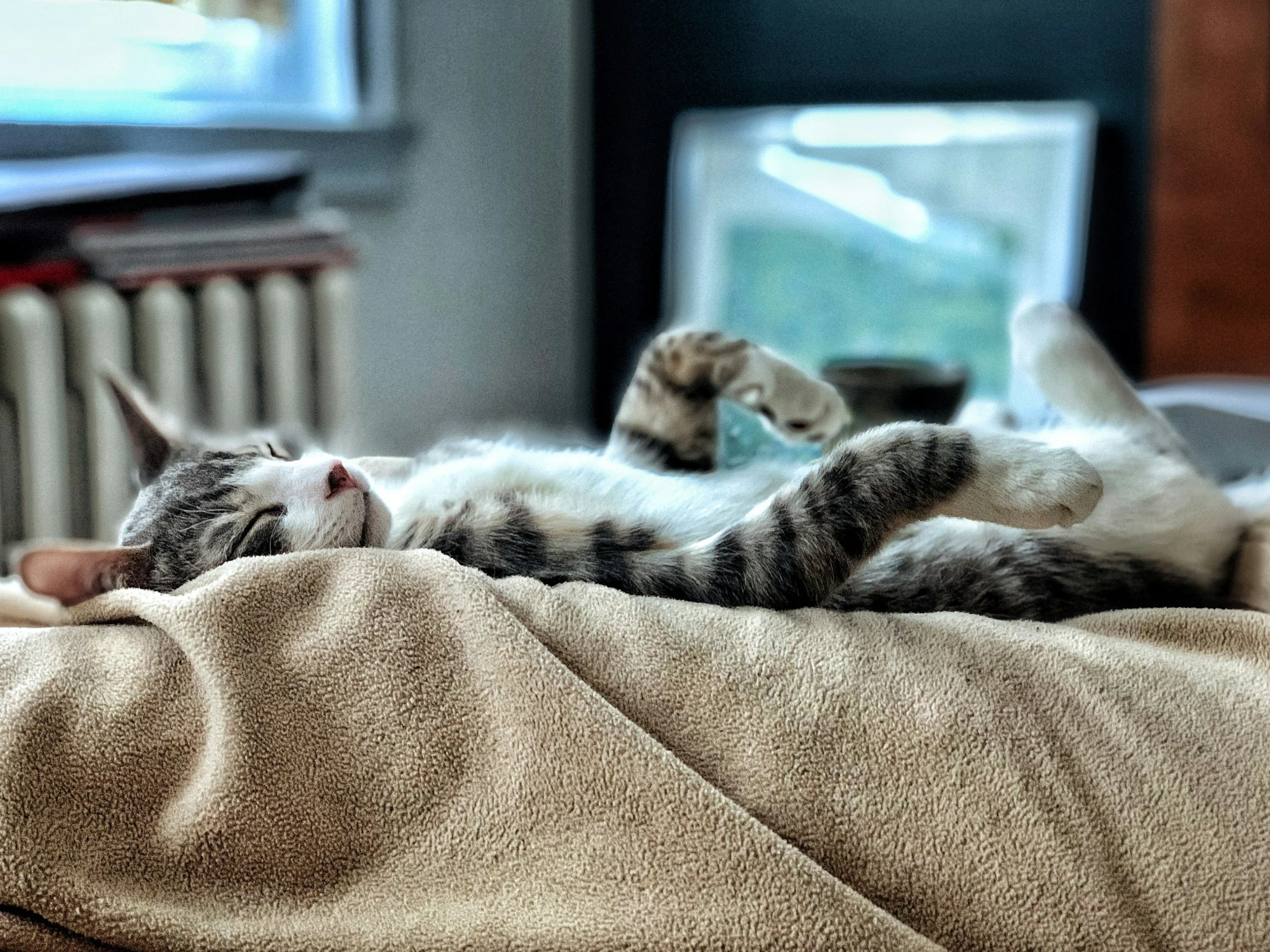
A tabby cat rests on its back, paws in the air and eyes closed, on a plush blanket. This image reminds us of the calm state of relaxation available to us when we coregulate with others and quiet our nervous systems. If we can’t access touch from other humans, our animal friends are great options as well.
How to Know If You’re Actually Co-Regulating Online
This is the question I get most often, and I love it because it’s a body-first question. Not “is this a good community?” but “what is happening in me when I’m in it?”
Co-regulation has a felt sense. Your nervous system knows. Here’s how to listen to it.
Signs You Are Co-Regulating
You arrive to the call or space activated (anxious, braced, scattered) and you leave softer. Not fixed. not solved. But less contracted.
You arrive to the call or space activated (anxious, braced, scattered) and you leave softer. Not fixed. Not solved. But less contracted.
Your breathing changes. It deepens, slows, drops into your belly. You might not notice it until after, but something in your body has let go a little.
You feel seen rather than evaluated. There’s a difference your nervous system knows even when your mind tries to talk you out of it.
You find yourself more able to tolerate difficult things (a hard diagnosis, a grief, a frustration) after being in the space. Not because the hard thing is gone, but because you’re not carrying it alone.
You feel the urge to share something true, and you do, and the response is attuned. Your body registers: I am safe here.
Time passes differently. The hypervigilant, clock-watching quality of a dysregulated state gives way to something more present.
You think about the people in the space between sessions. Not anxiously, but warmly. You wonder how they’re doing. That’s attachment forming. That’s your nervous system building a relational scaffold.
Signs You Are Not Co-Regulating
(And May Be Dysregulating)
Not all online spaces are healing spaces. Some of them are actively harmful to your nervous system, and it’s worth being honest about that too.
You leave more activated than you arrived — more anxious, more rageful, more hopeless, more numb.
You feel the compulsive pull to check, refresh, scroll. That’s not connection. That’s a dopamine trap masquerading as one.
You feel worse about yourself after engaging. More inadequate, more behind, more like you’re doing it wrong.
You perform rather than share. You craft rather than speak. There’s an audience relationship rather than a relational one.
You consume but don’t connect. Lurking, watching, reading…without any felt sense that you’re in anything.
You feel more alone after than before.
That last one is the clearest signal. Co-regulation leaves you less alone. If an online space consistently makes you feel more alone, regardless of how many followers it has or how beautiful its aesthetic is, your nervous system is telling you the truth about it.

A bright pink flower with lots of petals over a blurred background of leaves, demonstrating the importance of all the parts of the circle in creating completeness and the ability to contain itself. This is like a co-regulated online community.
What Co-Regulated Online Communities Actually Look Like
I’ve been in a lot of online spaces. I’ve facilitated them. I’ve studied them. And I’ve experienced, in my own nervous system, the difference between a digital space that regulates and one that doesn’t.
Here’s what I’ve noticed about the ones that work.
They Have a Consistent Rhythm
Co-regulation builds through repetition. The same time each week. The same opening ritual. The same voice welcoming you in. Predictability is a safety cue. When your nervous system knows what’s coming, it can settle rather than brace.
This is why drop-in content: a new post, a new video, a new offer — can be informative but rarely co-regulating. The spaces that actually change people’s nervous systems are the ones that show up on a schedule and mean it.
Someone Is Holding the Container
In in-person healing spaces, we talk about “holding space” — the practitioner or facilitator whose regulated nervous system creates a field that others can settle into. This is real, and it transfers online.
A co-regulated online community has someone whose job it is to stay grounded, to set the tone, to redirect when things tip dysregulating, and to model what it looks like to be present and honest without being activated. This doesn’t mean the facilitator never struggles — it means they’ve done enough of their own work to hold a thread of regulation even in hard conversations.
Communities without this tend to escalate, drift, or go flat. The nervous systems in the room have nowhere to borrow safety from.
It Requires Participation, Not Just Consumption
Co-regulation is a two-way process. You cannot be co-regulated by content you passively consume any more than you can be hugged by someone who doesn’t know you’re there.
The spaces that actually regulate are the ones where you have to show up — turn your camera on, share something, respond to someone, be seen. Not perform. Participate. There’s a difference, and your body knows which one you’re doing.
Vulnerability Is Welcomed and Witnessed
When someone in the space shares something true and difficult, and the community responds with attunement rather than advice-giving or dismissal, something happens in the nervous systems of everyone watching. Not just the person who shared. Everyone.
We’re wired to track the social field. When we see someone be vulnerable and survive it — be met with warmth, be seen without judgment — our own nervous system registers: it’s safe to be real here. That’s neuroception working across a screen.
There Is a Give and Receive
I wrote about this at length in the Stockheart piece, and it applies even more acutely online: mutual aid only works if it’s mutual. Online spaces have a particular tendency toward one-directional dynamics: a few people who share a lot, many who lurk, one person who holds everything together until they burn out and disappear.
Healthy online communities actively disrupt this. They create structures where everyone is invited to give something — a reflection, a resource, a question that opens something up. They notice when someone has been quiet. They ask. They redistribute the weight.
They Protect the Container
Not every topic belongs in every space. Not every behavior is compatible with nervous system regulation. The communities that work have clear agreements — not rigid rules, but shared understandings about how we talk to each other, how we handle conflict, what we do when someone is in crisis.
A community that allows chronic dysregulation — venting without movement, comparison spirals, advice-giving that overrides lived experience — will exhaust its members rather than regulate them. The container matters.

A gold magnifying glass on a rich pink background, signifying the act of searching, looking, or improving. It’s out there! Keep looking, and if you can’t find it, build it.
How to Find It, Build It, or Show Up Differently in It
Whether you’re looking for an online community that actually does this work, or you’re building one, or you’re already in spaces that could be more regulating if people showed up differently — here’s what I’d offer.
If You’re Looking for a Co-Regulated Online Space
Look for spaces with consistent, recurring structure — not just an archive of content.
Find spaces where the facilitator is visibly, consistently present — not just posting, but in relationship with the people there.
Ask yourself after your first few interactions: do I feel more or less alone? Trust that answer.
Seek spaces where real things are shared — not just wins, tips, and highlight reels.
Notice whether you’re invited to participate or just to consume.
If possible, choose spaces with a live component — video calls, voice, anything that transmits prosody and facial expression.
If You’re Building an Online Community
Design for rhythm. Same time. Consistent structure. Opening and closing rituals that the nervous system can recognize as signals of safety.
Use your voice and face. Record voice memos. Do live video. Let people hear and see you. Your regulated presence is the most powerful thing you can offer.
Create structures for mutual participation — prompts, breakout conversations, questions that ask people to share, not just respond.
Name the container explicitly. What is this space for? What’s the agreement about how we treat each other? Clarity is a safety cue.
Invite vulnerability by modeling it yourself. Share something true. Let people see you as a person who is also learning, not just a practitioner dispensing wisdom.
Build in a give-and-receive structure. Rotate who opens, who reflects back, who is witnessed each week. Redistribute the weight intentionally.
Know your own limits and plan for them. If you’re the sole regulated presence in a digital space, you will burn out. Build co-facilitation in from the start, or create pathways for members to become regulators for each other.
If You’re Already in Online Spaces That Could Be More Regulating
Turn your camera on. It matters more than you think.
Respond to someone specifically — not generally. “What you said about feeling invisible in your family landed for me” is co-regulating. “Great share!” is not.
Share something true, not just something useful. The relational field is built on vulnerability, not value delivery.
Let yourself be received. When someone responds to you with warmth, let it in. Notice if your impulse is to deflect or minimize. That’s worth being curious about.
Show up consistently. Relationships — including online ones — are built through repetition. Your nervous system is building a relational scaffold every time you return.

One person lying on their back with hands and feet in the air, balancing another person on their back contacting their feelt and shoulders. The background is a rose garden with mountains in the distance and a beautiful orange sunset painting the sky. This image denotes balance, mutual assistance, and active engagement.
A Special Note on Giving and Receiving Online
Online spaces are particularly prone to the helper-lurker split — a small number of people who give everything and a large number who consume without contributing. I understand why this happens. Sharing online feels riskier than sharing in person in some ways — it’s permanent, it’s public, you can’t see people’s faces when you say the true thing.
But the helper-lurker split is also a nervous system problem. The people who give everything without receiving eventually deplete — and because the depletion happens in a digital space, it can look invisible until it’s catastrophic. They disappear. They go quiet. They close the community they built or leave the one that needed them.
And the people who only consume miss the thing that actually regulates: being in it. Being witnessed. Being responded to. Receiving is not passive. It’s a full nervous system experience — but only if you make yourself receivable.
If you find yourself always in the helper role in online spaces — always the one with resources, with reflections, with the grounded response — I’d invite you to ask: who sees me here? Who holds space for what I’m carrying? And if the answer is no one, that’s not sustainable. Your nervous system will eventually enforce its own boundary, and usually not gently.
Mutual aid works online for the same reason it works anywhere: because everyone is included in the circle of care. That includes you.
You Don’t Have to Be in the Same Room to Belong to Each Other
I want to end with what I know from experience — both as a clinician and as a human being who has found genuine healing in digital spaces.
The people I’ve met through online learning cohorts, professional communities, and virtual healing circles have mattered to my nervous system. I have felt, in the middle of a video call with someone three time zones away who said exactly the right thing at exactly the right moment, something settle in my chest that I can only describe as recognition. Safety. The felt sense of not being alone.
That’s real. The neuroscience supports it. The research supports it. And if you’ve experienced it, your body already knows.
The screen is a limitation. It’s not a prohibition. And in a world where geographic isolation, chronic illness, disability, caregiving demands, and the simple reality of modern life mean that many of us can’t always get to a room full of people — building co-regulation online isn’t a consolation prize. It’s a lifeline.
Your nervous system needs others. Those others can be anywhere.
You don’t have to be in the same room to belong to each other. But you do have to show up.
🌿
References & Further Reading
Bravata, D., Russell, D., Fellows, A., Goldman, R., & Pace, E. (2023). Digitally enabled peer support intervention to address loneliness and mental health: Prospective cohort analysis. JMIR Formative Research, 7, e48864. https://doi.org/10.2196/48864
Coan, J.A., Schaefer, H.S., & Davidson, R.J. (2006). Lending a hand: Social regulation of the neural response to threat. Psychological Science, 17(12), 1032–1039.
IE Center for Health and Well-Being. (2025). Your voice says more than words: What it reveals about you. ie.edu
Porges, S.W. (2011). The polyvagal theory: Neurophysiological foundations of emotions, attachment, communication, and self-regulation. W.W. Norton.
Polyvagal Institute. (2026). What is polyvagal theory? polyvagalinstitute.org
Scientific Reports. (2026). Shared breath of joy enhances empathy through breathing synchronization. nature.com/articles/s41598-026-34981-0
Wright, K.B. (2016). Communication in health-related online social support communities: A review of research on predictors of participation, applications of social support theory, and health outcomes. Review of Communication Research, 4, 65–87.
Zhou, T. et al. (2020). How could peers in online health communities help improve health behavior. PMC. ncbi.nlm.nih.gov/pmc/articles/PMC7246899/
Read Part One of this series at Stockheart.com: “Beyond Self-Care: Building Co-Regulated Communities”