
The Five Roots of Whole-Person Health
And why you can't optimize your way to wellness
by Michele Renee, DC, MAc; Founder of Body Luminary

Tired and wired. Person at desk holding head. Whole health, integrative healthcare, health care. Holistic medicine. Functional approach. Root cause medicine. Tend the roots. Tending method.
There's a particular kind of exhaustion that doesn't show up on a lab report.
I've sat across from it hundreds of times. Someone comes in having done everything — the clean eating, the morning routine, the carefully researched supplements, the sleep tracking. They've been diligent in ways that most people aren't. And still, something remains dim. Not sick exactly, but not thriving either. Just…meh. And yet, your primary care doc can’t find anything “wrong” with you.
Before we go further, I want to be clear: your mainstream provider is not the problem. Generally speaking, mainstream providers are brilliant, dedicated professionals working really hard in a demanding system. Hats off to them for all they do to save lives!
The 20-minute annual wellness exam exists to make sure nothing terrible is happening. That's its actual job — and it's an important one. Your physician is looking for the things that require immediate attention, the values that fall outside a range, the signs that something needs to be caught. They are not — cannot be, in that container — having a conversation with you about how you're nourishing yourself, or what your sleep is really like, or whether the life you're living is one your body can actually settle into. That's not a failure of care. It's a failure of fit. You've been bringing a question to a room that was never built to hold it.
What I find myself wanting to do — what this space is for — is hold it differently. Not to fix what's wrong, but to sit with what's asking to be tended. Those are not the same thing, and the difference matters more than I can say in a single sentence.
Your body is not a problem moving toward a solution. It's more like a garden in the middle of a season you haven't fully named yet. Some things are dormant. Some things are composting — which looks, from the outside, a lot like dying, but isn't. Some things are quietly putting down roots you won't see evidence of for months. The question is never really is this healthy or not. It's closer to: what is alive here, what is asking for attention, and what does tending look like right now?
This is the conversation I didn't know I was looking for when I started practicing. I found it slowly, through my patients and through my own body, through years of noticing what actually moves people toward vitality — and what quietly keeps them from it. It almost never comes down to a single missing thing. It comes down to whether we're willing to look at the whole root system.
There are five domains I return to again and again, in my practice and in my own life. Not as a checklist — that's the very thing we're moving away from — but as a way of widening the lens. A way of asking not just what is off, but what is the whole of what this person is living in?
This is that widening. I'm glad you're here for it.

Yoga at the sea. Whole person care. Integrative healthcare. Holistic perspective. Wellbeing. Self-care. Connection. All bodies welcome.
The body itself
I start here not because it's the most important domain — I've come to think no single domain is — but because it's usually the one that brings people through the door. Something hurts. Something is off. The body has gotten loud enough that we finally stop and listen.
In whole-person care, I hold the body through two lenses at once. The first is functional: what is happening in the physiology? How are the hormones speaking to each other? Is the gut microbiome adding to the conversation or disrupting it? Is the nervous system cycling through stress and recovery, or has it simply forgotten how to come home?
The second is structural: how is this body moving through space? Where is it bracing, guarding, compensating? Are there patterns of tension so old they've become invisible — not felt as tension anymore, just felt as self?
This is why I practice chiropractic care and functional medicine together. The spine isn't separate from the stress response. The nervous system isn't separate from the gut. The body is not a collection of systems that happen to share the same address. It's one system, in constant conversation with itself — and the quality of that conversation matters.
Research in sensorimotor neuroscience has begun to map what practitioners have long intuited: that gentle adjustment of the spine influences not just musculoskeletal function but the brain's own processing of the body's signals. We are not, it turns out, just treating the back. We are changing the conversation.
The body is always speaking. Whole-person care is, in part, learning to listen — without immediately trying to make it say something different.

Baby with feelings sitting outside on a blanket. Emotional wellness. Dimensions of health. Wellness wisdom. Self-care. Integrative care. Whole person healthcare. Holistic healing. Functional medicine. Tend the roots.
The emotional body
We often separate the physical body and the emotional one, as if they are not inextricably linked. That never sat quite right with me, and when I studied Traditional Chinese Medicine, ultimately earning a master’s degree in this incredible medicine, I felt at home with the eastern understanding that they are not separate. In fact, they affect each other every day.
Emotions are not experiences that happen to the body. They are biological events that happen in the body. Every feeling you've ever had — grief, anxiety, joy, the low hum of dread you can't quite name — has a physiological signature. A cortisol pattern. An inflammatory cascade. A change in gut motility, heart rate variability, immune function.
Chronic stress is not a psychological inconvenience. It's a sustained physiological state with measurable downstream effects on virtually every system we care about. You cannot supplement or exercise your way around a nervous system that never feels safe. I've watched people try.
What I find more useful (and what the research is beginning to confirm) is something simpler and harder: learning to be with difficult emotions rather than through them. A gradual, patient development of the capacity to feel what's present without being overtaken by it.
This is emotional tending. It's slow work. It often doesn't look like work at all. But it changes the body in ways that no protocol can reach.
You cannot supplement or exercise your way around a nervous system that never feels safe.

Best friends. Dog and person looking at the sunset over the sea. Whole person care. Integrative healthcare. Holistic healing. Connection matters. Tend the roots. Healing together. Relational body.
The relational body
We are not built for solitude. This isn't a preference — it's a biological fact.
The research on social connection and health is among the most consistent in all of medicine. Loneliness carries health risks that rival smoking. Deep, safe relationships are protective in ways that reach all the way down to cellular aging. We are, at the level of our physiology, shaped by who we're connected to and how.
I think about relationships in this context more broadly than just close friendships or partnership — though those matter enormously. I think about the relationship you have with your own body. The quality of attention you bring to it. Whether you approach it with curiosity or criticism, with trust or with a kind of low-grade hostility that never quite goes away.
And I think about the relationship you have with the healthcare system itself.
A note on that
If you've spent years being told your labs are normal while you feel terrible, something lives in you from that. If you've received a frightening diagnosis without adequate explanation, or felt rushed, or left a clinic without understanding what had just happened — those encounters leave traces. They shape whether you seek help, whether you trust your own perceptions, whether you feel like an active participant in your care or a passive recipient of other people's conclusions.
This is part of what whole-person care is trying to tend. Not just the body you came in with, but the story you've been carrying about what it means to be a body in need of care. That story deserves attention too.

Meditation at sunset on the deck. Zen practice. Deep breathing. Tend the roots. Integrative healthcare. Whole person care. Holistic healing. Connecting on the inside. Accepting what is. Being present with self.
The daily body
This is where most health content lives, and I want to be careful here. Because this domain is real and important, and also the one most likely to be co-opted by the optimization culture we're trying to step back from.
What you eat, how you move, how you sleep, how hydrated you are, which supplements you're actually absorbing versus which are moving through you untouched — these things matter. They matter a great deal. Food quality alone, the research suggests, accounts for more preventable disease burden in the United States than any other single behavioral factor.
But here's what I've learned from sitting with people across years of practice: behaviors don't exist in isolation. They're downstream of everything else. The person who knows exactly what to eat but is too exhausted by grief to cook it. The person with a perfect supplement protocol whose stress physiology is overriding its effects. The person who exercises every day as a form of self-punishment, and wonders why their body still feels like the enemy.
In the tending paradigm, daily practices aren't a checklist to execute. They're acts of attention toward a living system. The question shifts from am I doing this correctly to is this nourishing me — is this what my body actually needs, in this season, right now?
That's a different question. And it leads somewhere different.
Your daily habits are not the foundation of your health. They're the expression of it. Tend the roots, and the behaviors begin to change on their own.

Person standing by the sea appreciating the sunrise. Sense of awe. Connection. Part of something bigger. Meaning making. Purposeful living. Tend the roots. Integrative healthcare. Holistic healing. Whole person care. Whole health. Tune in. Self-care.
The meaning-making body
This is the domain I thought, for a long time, was separate from medicine. I've come to believe it may be the one that holds everything else together.
Purpose is not a luxury. It's a physiological variable. The research on meaning and longevity is remarkable — higher levels of purpose in life are associated with reduced risk of heart attack, stroke, and all-cause mortality, effects that persist even after controlling for the usual suspects. We are not merely psychological beings who happen to have bodies. We are meaning-making creatures, and our bodies know when the meaning has gone missing.
I notice this in patients who are doing everything right by every measurable standard — and who are still, quietly, not thriving. Sometimes what's missing isn't a nutrient or a sleep habit. It's a reason. A sense that the life they're living is theirs, that it reflects something true about who they are and what they care about.
These aren't questions I can answer for anyone. But I can create a space where they're allowed to be asked. Where the conversation about health is wide enough to include: what are you living toward? Does the shape of your days reflect what matters to you? And if not — what would it take to let it?
Those are health questions. Some of the most important ones I know.
Why tending one root is never quite enough
I want to mention a pattern I see, and maybe you recognize yourself in it.
Someone comes in having already done significant work on one domain — usually the body, sometimes the behavioral one. They've overhauled their diet. They've added the right supplements. They've made real changes. And they've plateaued. Not because the work wasn't real, but because another domain has been quietly running in the background, pulling in the other direction.
The person who eats beautifully but lives inside a relationship that never feels safe. The person whose cortisol is so chronically elevated that no anti-inflammatory protocol can keep pace. The person who has organized their entire identity around being ill — who, when real improvement begins to come, doesn't quite know who they are without the illness, and so the body, sensing the confusion, holds back.
This is what happens when we tend one root while the others remain untended. The entire garden can't flourish that way, no matter how much attention we give to a single plant.
The biopsychosocial model — the framework in medicine that accounts for biological, psychological, and social factors simultaneously — has been the most empirically supported model in medicine for decades. And yet it remains chronically under-implemented in practice. The 20-minute appointment simply cannot hold it.
What I want to offer is a different container.
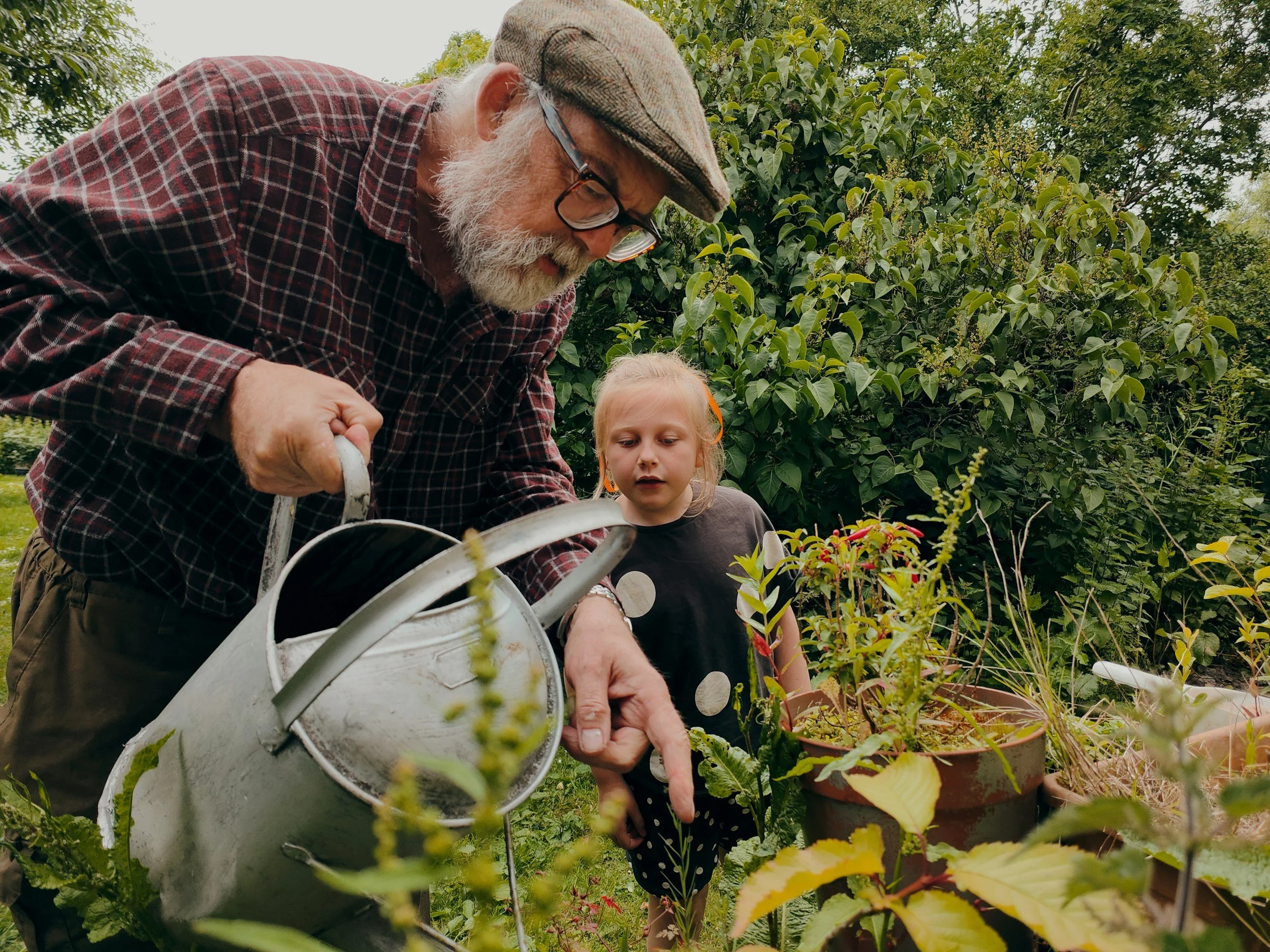
Older person and child gardening together. Intergenerational healing. Tending the roots. Integrative healthcare. Whole person care. Healing from the inside. Functional medicine. Slow medicine. Listen to what is needed. Holistic healing. Tending Method.
Gardening, not fixing
Most of us were taught to think about health in terms of fixing. Something is broken; we repair it. Something is off; we correct it. The body is a machine, and the clinic is the repair shop.
This metaphor saves lives in acute care. But for the slower, quieter struggles — the chronic fatigue, the low-grade inflammation, the sense that something is off that no test can name — it consistently falls short. Because the body is not a machine. It is a living system, and living systems don't respond to fixing. They respond to tending.
Tending is a different kind of attention. It's not passive — a good gardener is always paying attention, always making small adjustments, always reading what the plants are asking for. But it's attentive without being controlling. It trusts the intelligence already present in the system. It works with the body rather than on it.
In practice, this means approaching symptoms as information rather than malfunction. It means recognizing that rest and integration are part of the process, not interruptions to it. It means asking not just what is wrong but what does this body need in order to move toward more of itself.
For people living with chronic illness, this reframe can change something fundamental: the quality of the relationship. When you stop treating your body like a problem and start treating it like a garden, something in the holding changes. There's less struggle. More listening. And often, eventually, more movement.

Majestic view. Yellow flowers in the foreground. Peaceful feeling. Holistic healing. Integrative healthcare. Whole person care.
What changes when you tend the whole system
Honestly, this is not a quick process. It's not a protocol with a timeline. It's an orientation — a way of paying attention that, over time, begins to change what's possible.
What I watch happen, when someone commits to this kind of tending, is less like recovery and more like return. A gradual coming back to a self that was always there, waiting. The relationship with the body shifts from adversarial to curious. Symptoms that weren't directly targeted begin to quiet. There's more capacity — not because everything is fixed, but because the whole system is moving in the same direction.
This is available to you whether you're navigating a complex chronic illness or simply living with the sense that you could feel more like yourself than you currently do. The five domains don't discriminate. They're simply the whole of what it is to be human in a body.
I didn't know I was looking for this conversation when I started practicing. I found it slowly, the same way I find most things worth finding — by paying attention to what kept coming up, again and again, until I couldn't look away from it anymore.
I'm glad you're here for it.
The Tending Practice
Most of us were never taught how to live in a body long-term. The Tending Practice is a monthly membership for learning — slowly, honestly, and with people who understand. Monthly calls, resources, and community. Three tiers, starting at just $19/month.
bodyluminary.com/tending-practice
References
1. Haavik H et al. The role of spinal manipulation in addressing disordered sensorimotor integration. Journal of Electromyography and Kinesiology, 2021.
2. Kiecolt-Glaser JK et al. Psychological stress, immunity, and upper respiratory infections. American Psychologist, 2019.
3. Holt-Lunstad J, Smith TB, Layton JB. Social Relationships and Mortality Risk. PLoS Medicine, 2010.
4. Mozaffarian D. Dietary and Policy Priorities for Cardiovascular Disease, Diabetes, and Obesity. Circulation, 2016.
5. Kim ES et al. Purpose in Life and Reduced Risk of Myocardial Infarction. JAMA Psychiatry, 2013.
6. Borrell-Carrio F, Suchman AL, Epstein RM. The Biopsychosocial Model 25 Years Later. Annals of Family Medicine, 2004.